Elevate your homemade sushi game to a whole new level with perfectly crafted egg sheets. If you’ve ever admired the delicate, golden layers of usuyaki tamago or kinshi tamago in professional sushi rolls or bento boxes, you might be surprised to learn that your trusty crepe maker is your secret weapon for achieving them with ease and consistency. Forget the struggles of uneven cooking and tearing; this guide will transform your crepe maker into an egg sheet factory, allowing you to create beautiful, pliable sheets ideal for your next sushi masterpiece.
The Art of Usuyaki Tamago: Why Your Crepe Maker is Perfect
Usuyaki tamago refers to thin, often subtly sweetened Japanese egg sheets, a staple in sushi and bento. When cut into fine strands, they become kinshi tamago, a vibrant garnish. Traditionally made in a rectangular tamagoyaki pan or a round skillet, achieving uniform thinness and preventing tears can be a challenge. This is where your crepe maker shines.
Crepe makers offer several undeniable advantages:
- Even Heat Distribution: Their flat, expansive surfaces provide consistent heat across the entire cooking area, crucial for uniform cooking and preventing hot spots that can scorch delicate eggs.
- Non-Stick Surface: Most modern crepe makers boast excellent non-stick coatings, ensuring your thin egg sheets release effortlessly without tearing.
- Large Surface Area: A generous cooking surface allows you to make larger sheets, which are ideal for wrapping sushi rolls or cutting into various shapes.
- Ease of Thinness: The design of a crepe maker, often with a low rim or even a dipping plate, naturally encourages the creation of exceptionally thin layers, perfect for sushi.
Gather Your Essentials: Ingredients & Tools
Before you start, make sure you have everything ready for a smooth cooking process.
Ingredients
The magic of usuyaki tamago lies in its simplicity, with just a few basic ingredients:
- Eggs: 3-4 large eggs are usually sufficient for several sheets.
- Liquid: 2-3 tablespoons of water, dashi (Japanese soup stock), milk, or sake. This helps to thin the batter for delicate sheets.
- Sweetener: 1-2 teaspoons of sugar. Adjust to your preference for a subtly sweet or savory sheet.
- Seasoning: A pinch of salt. Optionally, a dash of soy sauce for a savory umami note, though it might slightly darken the color.
- Oil: A small amount of neutral oil (vegetable, canola, or grapeseed) for greasing.
|
Our Picks for the Best Crepe maker in 2026
As an Amazon Associate I earn from qualifying purchases.
|
||
| Num | Product | Action |
|---|---|---|
| 1 | Nutrichef Electric Crepe Maker - 8-inch Nonstick Cooktop with On/Off Switch - Cooks Roti, Tortillas & Pancakes - Automatic Temperature Control & Cool Touch Handle - Includes Food Bowl, Whisk & Spatula |

|
| 2 | Nutrichef Electric Crepe Maker & Griddle Cooktop - Nonstick 12 Inch Aluminum Hot Plate with LED Indicator Lights & Adjustable Temperature Control - Wooden Spatula & Batter Spreader Included |
|
| 3 | Baker's Friend Instant Crepe Maker with Handle, Electric Crepe Maker Machine, Crepera Electrica, 8 Inch Non-stick Cooking Surface, Aqua |
|
| 4 | Moss & Stone Electric Crepe Maker – 8” Portable Crepe Pan Nonstick with Dipping Plate, Auto Shut-Off, On/Off Switch, Even Heating & One Automatic Temperature Control – Compact Crepe Maker |
|
| 5 | Moss & Stone Electric Crepe Maker 8 Inch, Portable Crepe Maker & Hot Plate Cooktop On/Off Switch, Nonstick Coating, Automatic Temperature Control, Easy To Use For Pancakes, Blintz, Chapati |
|
| 6 | Moss & Stone 12” Electric Griddle Pan & Crepe Machine, Non-Stick Electric Crepe Maker with Adjustable Temperature, Includes Spreader & Spatula – Ideal for Pancakes, Blintzes & Tortillas |
|
| 7 | Gourmia 12” Crepe Maker – Nonstick Electric Griddle for Pancakes, Omelets & More, Precise Temp Control with Indicator Lights, Includes Spatula & Batter Spreader, Quick Cleanup, Stainless Steel Trim |
|
| 8 | Gourmia 8” Electric Crepe Maker – Nonstick Ceramic Surface, One-Touch Operation, Includes Batter Tray, Compact & Easy to Clean, Crepe, Pancake & Tortilla Maker |
|
| 9 | 16 Inch Commercial Crepe Maker, Dual-Head, Dual Zone Temp Setting, Nonstick Pancake Griddle Machine, 50-300°C(120-570℉), 3400W, S.S. Shell, for Catering, Restaurant, Snack Stand, CE Certified |
|
| 10 | Electric Crepe Maker 12'' & Griddle - Non-Stick Pan With Spreader for Roti, Tortilla, Blintzes, Pancakes - Adjustable Temperature, 1000W |
|
Tools
Having the right tools will make the process much smoother:
- Electric Crepe Maker: Your primary cooking surface.
- Whisk: For thoroughly beating the eggs.
- Fine-Mesh Sieve: Essential for straining the egg mixture to remove chalazae and ensure a silky-smooth batter.
- Ladle: For portioning the egg mixture onto the crepe maker.
- Crepe Spreader (Optional but Recommended): A T-shaped tool that helps spread the batter thinly and evenly.
- Thin, Flexible Spatula: For carefully lifting and removing the cooked egg sheets.
- Shallow Bowl/Plate: For resting cooked sheets.
Step-by-Step Guide: Crafting Egg Sheets on Your Crepe Maker
Follow these steps for flawless usuyaki tamago every time.
Step 1: Prepare the Egg Mixture
In a medium bowl, crack the eggs. Add your chosen liquid (water, dashi, etc.), sugar, and salt (and soy sauce, if using). Whisk vigorously until the yolks and whites are fully combined and the mixture is uniform. The goal is to avoid any streaks of clear egg white. For the smoothest possible sheets, pass the entire mixture through a fine-mesh sieve. This removes any remaining chalazae or bits of unbeaten egg, ensuring a delicate texture.
Step 2: Preheat Your Crepe Maker
Turn on your crepe maker and set it to a medium-low temperature. For most models, this will be around 300-325°F (150-160°C). The key is gentle heat; too high, and your egg sheets will brown too quickly or become crispy, losing their desired pliability. Allow it to fully preheat for 5-7 minutes to ensure even surface temperature.
Step 3: Lightly Grease the Surface
Using a paper towel dipped in a small amount of neutral oil, lightly wipe the entire cooking surface of your preheated crepe maker. You only need a thin film; excessive oil can lead to a greasy finish or uneven cooking. This ensures a perfect non-stick release for each sheet.
Step 4: Pour and Spread
Once the crepe maker is hot and lightly oiled, ladle a small amount of the strained egg mixture onto the center. The exact amount will depend on the size of your crepe maker and your desired thickness, but typically 2-3 tablespoons per sheet is a good starting point. Immediately use a crepe spreader to gently and quickly spread the egg mixture outwards in a circular motion, forming a very thin, even layer. If you don’t have a spreader, you can gently tilt the crepe maker to coat the surface, though a spreader offers more control.
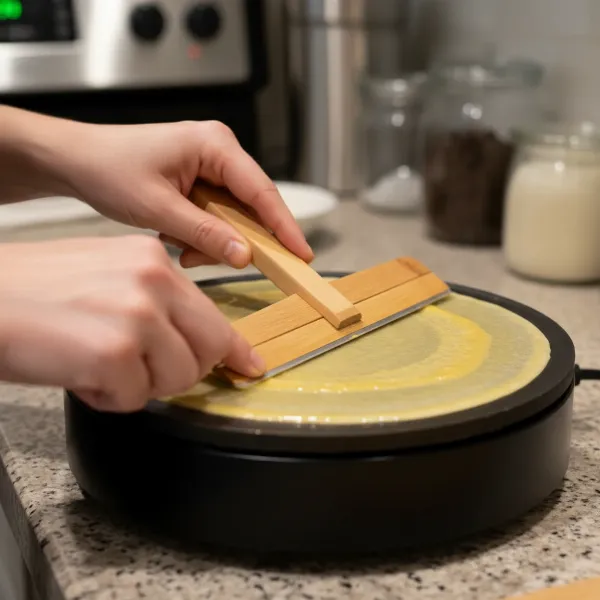 Crepe maker spreading thin egg batter with T-spreader for usuyaki tamago
Step 5: Cook Until Set
Allow the egg sheet to cook for about 1-2 minutes. You’ll know it’s ready when the edges begin to dry and curl slightly, and the entire surface of the egg appears set, with no visible wet spots. The sheet should remain pale yellow and flexible. Avoid overcooking, as this can make the sheets brittle and difficult to roll.
Step 6: Carefully Remove
Using your thin, flexible spatula, gently slide it under one edge of the cooked egg sheet. Carefully lift and peel the sheet from the crepe maker. If the sheet resists or tears, it might need another few seconds of cooking, or your temperature might be too high.
Step 7: Cool and Stack
Transfer the cooked egg sheet to a clean plate or cutting board. Repeat the oiling and cooking process for the remaining egg mixture. As you finish each sheet, stack them gently on top of each other. Once all sheets are cooked, allow them to cool completely before using or cutting. This prevents steaming and sticking.
Types of Crepe Makers for Egg Sheets
While all electric crepe makers can make egg sheets, different styles offer varying experiences.
Tabletop Crepe Makers
These are the most common type, featuring a flat, round heating surface with a control dial. They are excellent for egg sheets due to their precise temperature control, allowing you to dial in the perfect low heat to prevent browning. Their stable design makes pouring and spreading easy, leading to consistently thin and uniform sheets, ideal for those who make sushi frequently.
Handheld/Dip Crepe Makers
Less common but highly effective for ultra-thin results, these feature a heated non-stick surface that you dip directly into a shallow bowl of batter. This method creates an incredibly thin, even coating of egg. While they might require a bit more practice for perfectly round shapes, their dipping mechanism is a unique way to achieve delicate, almost translucent egg sheets, which can be fantastic for very intricate sushi presentations.
Tips for Perfect Sushi Egg Sheets
Achieving sushi-grade egg sheets is all about technique and a few key pointers.
Achieving Uniform Thinness
The secret to perfectly thin egg sheets lies in two factors: a well-diluted egg mixture and quick, even spreading. Ensure your egg mixture is well-strained and flows easily. When spreading, apply gentle, consistent pressure with your crepe spreader, moving quickly before the egg sets. “The consistency of your batter and the speed of your spread are paramount for creating those delicate, translucent egg sheets that make sushi truly shine,” says Chef Akiro Tanaka, a Japanese culinary instructor.
Preventing Tears
Tearing often happens due to undercooking, overcooking, or impatient removal. Ensure the egg is fully set across the entire surface but still pliable. Use a very thin, flexible spatula and slide it completely under the sheet before lifting. A lightly oiled surface is also critical for a clean release.
Avoiding Browning
For traditional usuyaki tamago, a pale yellow color is desired. This is achieved by cooking at a low temperature. If your sheets are browning, reduce the heat on your crepe maker. It’s better to cook slower and maintain the delicate color.
Flavor Variations
While sugar and salt are standard, you can experiment with flavors. A touch of mirin (sweet rice wine) adds a subtle sweetness and depth. Dashi, a Japanese broth, provides umami. For a richer flavor, a tiny splash of cream or milk can be used, though this might make the sheets slightly less delicate.
Storage
Once cooled, stack your egg sheets with parchment paper in between to prevent sticking, and store them in an airtight container in the refrigerator. They are best used within 2-3 days. They can also be carefully wrapped and frozen for up to a month, though texture may slightly change.
Troubleshooting Common Issues
Even experienced cooks face challenges. Here’s how to address them:
- Eggs sticking: Ensure your crepe maker is thoroughly preheated and lightly re-oiled before each sheet. Your non-stick coating might also be wearing down.
- Sheets too thick: Your egg mixture might not be thin enough, or you might be using too much batter per sheet. Try adding another tablespoon of liquid to your mixture and use a smaller ladle portion.
- Sheets tearing: The egg is likely either undercooked (too fragile) or overcooked (brittle). Adjust cooking time slightly and ensure you’re using a thin spatula.
- Edges getting crispy: This is a sign the heat is too high. Reduce the temperature setting on your crepe maker.
Creative Uses Beyond Sushi
While perfect for sushi, these versatile egg sheets have many other applications:
- Bento Box Wraps: Use them to wrap small portions of rice, vegetables, or even other proteins for a beautiful and edible presentation.
- Garnishes for Salads/Soups: Cut into thin strips (kinshi tamago) to add color and texture.
- Low-Carb Wraps: A fantastic, gluten-free alternative to tortillas or bread for light wraps and sandwiches.
- Layered Dishes: Use as a delicate layer in savory cakes or terrines.
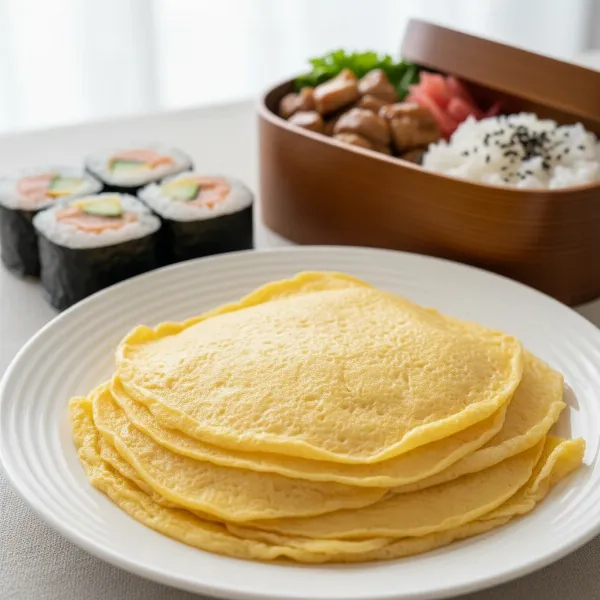 Stack of thin usuyaki tamago egg sheets on a plate, with sushi and bento elements
Conclusion
Making exquisite egg sheets for sushi on your crepe maker is not only achievable but surprisingly straightforward. By mastering the art of the perfect batter, precise temperature control, and gentle handling, you can consistently produce delicate, flavorful usuyaki tamago that will impress your family and friends. This versatile technique opens up a world of culinary possibilities, from traditional sushi rolls to creative bento designs. So, dust off your crepe maker and start experimenting – your homemade sushi will thank you! What delicious sushi creations will you embark on first with your perfectly crafted egg sheets?
Frequently Asked Questions
Can I use a regular pan instead of a crepe maker?
Yes, you can use a well-seasoned non-stick skillet to make egg sheets, but it requires more skill to achieve uniform thinness and even cooking. A Crepe Maker’s consistent heat and flat surface often make the process easier, especially for beginners.
How thin should the egg sheets be?
Ideally, egg sheets for sushi should be as thin as possible without tearing, often almost translucent. This allows them to be flexible for rolling and prevents them from overpowering the other sushi ingredients. Aim for about 1-2 millimeters in thickness.
What if my egg sheets keep tearing?
Tearing is usually due to the egg being undercooked, overcooked, or the surface not being adequately greased. Ensure the egg is fully set but still pliable before attempting to remove it, and use a very thin, flexible spatula for gentle lifting.
Can I make them ahead of time?
Absolutely! Egg sheets can be made 1-2 days in advance. Once cooled, stack them with parchment paper in between, place them in an airtight container, and store them in the refrigerator. They are perfect for meal prep.
What’s the difference between usuyaki tamago and tamagoyaki?
Usuyaki tamago refers to very thin, flat egg sheets, often used as wraps or garnishes. Tamagoyaki is a thicker, layered Japanese omelet, typically cooked in a rectangular pan and rolled up repeatedly to create a dense, sweet-savory block that is then sliced.